

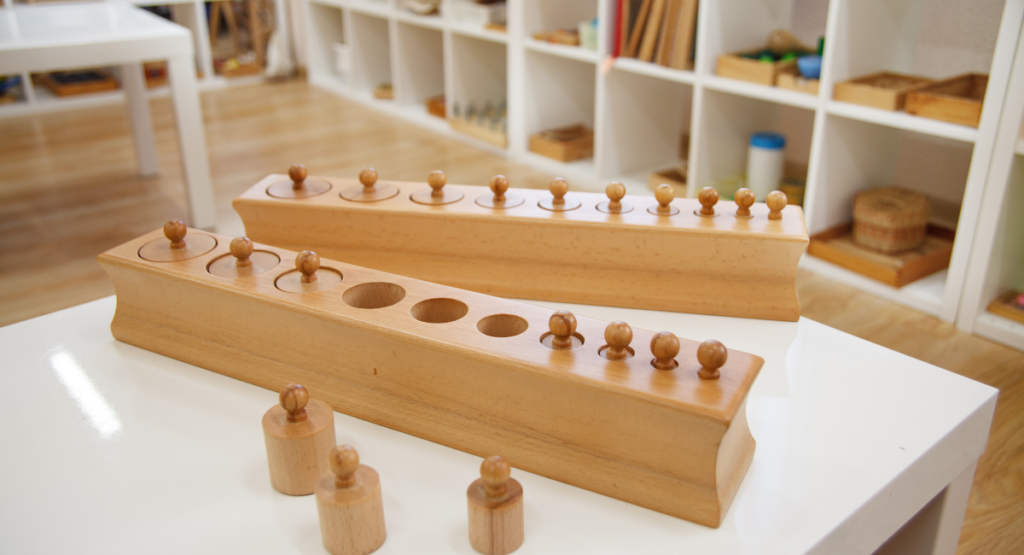
Montessori is a method of education for children age 0-18 that allows children to make choices in their learning while teachers trained in the method guide the process. The education method is hands-on, self-directed, and also includes collaborative play. Children work both in groups and independently in mixed age classrooms.
"Never let a child risk failure until he has a reasonable chance of success."
Dr. Maria Montessori Tweet
Who Is Dr. Maria Montessori?
In the early 1900s, Dr. Maria Montessori, an Italian physician and anthropologist, was given the responsibility of caring for a group of children in Rome’s San Lorenzo slum district. The children at this particular nursery were thought to be undisciplined and impossible to educate. Dr. Montessori was a known child advocate and often spoke about the value of children to our future societies- she was eager to accept the challenge of looking after and teaching these underserved children. Over the next five years, she observed the children and their responses to the environment and watched them develop capabilities and interests that exceeded her expectations and previous thoughts about age appropriate development. She began to understand the critical importance of a positive, nurturing environment that adapts to meet the needs of the developing child.
Dr. Montessori noticed universal patterns of child development that transcend culture and environment. She developed a highly specific curriculum with corresponding learning materials to be used in the “Montessori” environment. The objective was to create concrete, physical representations of the concepts and skills that are intuitive to children during the course of natural development.
Although she passed away in 1952, her educational approach designed to support, nurture, and protect the natural development of children is used around the world to educate hundreds of thousands of children.
"The goal of education is the development of a complete human being, oriented to the environment, and adapted to his or her time, place, and culture."
Dr. Maria Montessori Tweet
How Are Montessori Teachers Different?
Montessori teachers are educators who have received a comprehensive, AMI teacher training taught by master AMI trainers who have demonstrated a mastery of educational theory, child development, observation techniques, as well as the implementation of the method and materials.
What Does A Montessori Classroom Look Like?
"A Montessori classroom is a place of calm concentration."
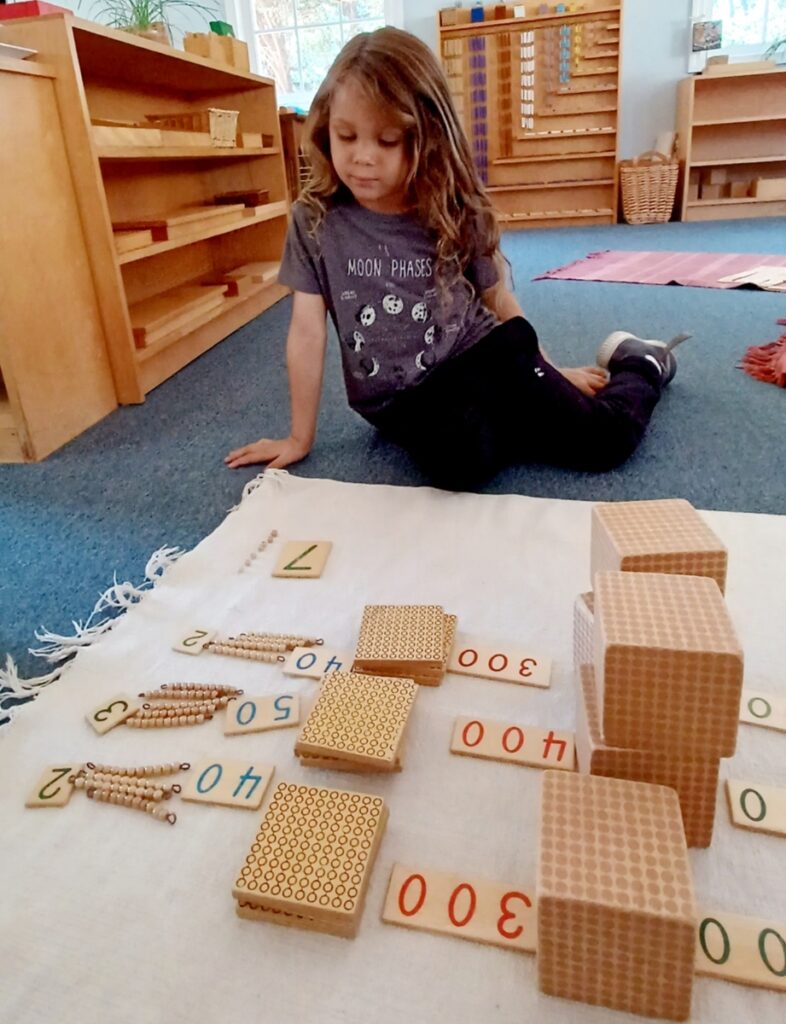

Classrooms are peaceful, inspiring spaces meticulously designed to meet the developmental needs of children as they progress through every stage of child development. These classrooms are considered to be “prepared environments.”
Features of a Montessori Classroom
Here are the most notable features of Montessori classrooms:
- Every object and every piece of furniture is perfectly scaled to the size of the children served in that classroom
- There is no focal point, but rather several engaging spaces.
- Various types of spaces encourage group learning, independent learning, outside play, table activities, and floor activities.
- All objects in the room are constructed of natural materials- mostly wood.
- Every object has an intellectual purpose, including the color and how it is presented- even the wall hanging are meant to be intellectual experiences.
- Many classrooms include kitchens and cleaning stations.
- Movement through the classroom is unrestricted, unless it endangers them or their classmates.
- Materials are placed in a left to right progression from easiest to most difficult, providing a structured pathway for learning.
Elements of the Prepared Environment
As we mentioned, the classroom and every other space is methodically ordered to promote child development. The prepared environment has ten main elements.
Order
Learning spaces are calm, ordered, and consistent. Children know what to expect from the space and what is expected from them. Each curriculum area has a series of dedicated shelving, space at a table, and space on the floor. An ellipse is where children gather for group time or story time, and a designated meal area is established. The flow of play, exploration, and learning is intrinsic to children.
Right-Size
The Montessori method recognizes that an adult sized world can be frustrating for small people. Prepared environments will always have child sized furniture, accessible shelving and storage, and child sized learning materials. The size of the objects and furniture help children develop mastery and confidence in a space made for them.
Aesthetics
The neutral and natural wood colors in classrooms are soothing and beautiful. Each learning material is crafted with beauty in mind and should be placed within reach and with ample space around it. Clutter is not acceptable in a Montessori classroom. Art completed by children is neatly displayed in a specific space.
Actual
Children pour water for themselves from a real pitcher into a real glass. Photos of actual animals and objects are placed on the walls. You will not find plastic, cartoons, or audio-visual equipment in this type of classroom, because the education is based on the real world.
Choice
The prepared environment offers choices where children are free to involve themselves in their own interests on their own time. Limits are not set for what or for how long a child interacts with a learning material.
Consistency
Once the classroom is set up, it rarely changes. Children take comfort in knowing where to find specific objects. Core materials remain and new activities are introduced with new learning materials in specific areas of the space. For example, the metal insets remain on the same shelf, but the science area has transitioned from birds to reptiles.
Left to Right
Classrooms have dedicated curriculum areas and within those areas, materials are placed from left to right in progressive order from easiest to hardest. This layout communicates a clear path for learning to children.
Harmony
Montessori environments create a distinct sense of harmony. Even the most active children move intentionally, define their learning spaces, and respect their fellow students in the classroom. Children naturally work together, when appropriate, to master skills and to explore.
Freedom
Montessori classrooms have established rules within their prepared environment. As long as they respect those rules, they may move freely throughout the learning spaces and choose their own work.
Independence
The design of the classroom allows children to develop their independence. Children are actively encouraged to do and think for themselves both within school and at home.
Core Areas of Learning
- Practical life
- Sensorial
- Language and literacy
- Mathematics
- Cultural
- Creative
What Are The 10 Principles of Montessori Education?
During Dr. Montessori’s time caring for children in a nursery in a slum in Rome, she developed core principles necessary to nurture a child’s education through the Montessori method.
1. Respect for Child
A deep and abiding respect for children is a guiding principle of the Montessori method. Embracing each child’s uniqueness, their freedom to move, express themselves, correct their own mistakes, and work at their own natural pace is at the center of teaching. Genuine respect for each child is essential to implement this method as intended.
2. Absorbent Mind
Years of research led Dr. Montessori to understand that the stage from 0-6 years old is the time in a child’s life when they have an absorbent mind. This means that they absorb information like a sponge, at a staggering pace. Exposing children to a Montessori environment during this time will help to construct the foundation of their intelligence and personality.
3. Sensitive Periods
Dr. Montessori’s research led her to understand that children pass through specific times in their development when they are at heightened capability of learning specific knowledge areas or skills. These sensitive periods are windows of opportunity for Montessori trained teachers to introduce materials that will accelerate learning.
4. Educating the Whole Child
Children are viewed holistically in Montessori schools. The whole child is nurtured through experiences that nurture their intellect, physical body, emotions, and social development. All aspects of life development are viewed as equally important.
5. Individualized Learning
6. Freedom of Movement and Choice
7. Prepared Environment
8. Intrinsic Motivation
9. Independence
10. Auto-Education
Does Montessori Accreditation Matter?
Just like in other school settings, paying attention to accreditations is important. The Montessori name and method are part of the public domain- not trademarked. This means that any school can claim to be Montessori. The only way to ensure that the school you are considering is truly a Montessori school is to verify that they are a member of a governing body, such as the Association Montessori Internationale (AMI). Schools with this accreditation have deemed authentic Montessori education centers that follow Dr. Montessori’s intended curriculum. When a school is accredited, they have accountability and oversight.
What Are the Advantages of a Montessori Education?
Why would you send your child to a Montessori school over any other education model? Montessori schooling has distinct advantages over other types of schooling and those advantages are backed by research.
Montessori Students Are Self-Motivated Learners
Children innately enjoy learning. It is when they feel as if their choices for learning are taken from them that they may become resistance. When given the space to learn at their own pace and according to their own interests, their love of learning persists. The Montessori method is designed to foster a love of learning and an insatiable curiosity that stays with them for their lives. The curriculum has been widely used for more than 100 years and is recognized for teaching children well beyond the basic reading, writing, and arithmetic.
Montessori Education Improves Social and Problem Solving Skills
Children who receive a Montessori education typically interact better with peers. One reason for this is that they learn in multi-age classrooms where they engage with other children of varying skill and developmental levels. Montessori children are encouraged to peacefully resolve conflicts on their own using compromise and problem solving skills. Because Montessori classrooms are typically culturally diverse, children grow up learning the importance of different perspectives and backgrounds.
Montessori Students Excel At Reading and Math Abilities
Reading is a cornerstone of a Montessori education. From very early ages, children learn poetry and storytelling. Because literacy is essential for discovery, great importance is placed on reading in a Montessori classroom. In a 2017 study of children enrolled in many different education models, Montessori students demonstrated a more advanced set of literacy and math skills than non-Montessori peers.
Montessori Educate Cultivates Compassion and Confidence
Montessori classrooms are carefully designed to teach much more than reading and writing. The prepared environments help children develop self-esteem and respect for others. Because the Montessori education calls for a similar home life, children demonstrate more kindness and responsibility both at home and in the world.
Is Montessori Right For Your Child?
There are many factors to carefully consider when deciding whether a Montessori education is right for your child. Here are some things to think about when making a choice:
Local Montessori Options
Unfortunately, not all Montessori schools are created equally. Some Montessori schools focus more on education, while others are more connected to nature and may hold class outdoors. Each Montessori school has its own mission and it is important to make sure it is aligned with your goals and preferences for your child. Make a list of local Montessori schools and take time to research each one. Schedule a tour ask questions such as:
- Do the teachers have high quality Montessori training?
- Are the classroom materials Montessori materials and are they in good condition?
- The environment is orderly, but happy and relaxed.
- The children are playing and learning independently.
Preparation Of The Home
The Montessori method relies on a child’s developmental needs being met in both the home and school environment. If you think that Montessori may be right for your child, consider whether you are willing and able to make appropriate changes in your home to provide consistency.
Physical Home
As a child develops and moves through milestones, the physical environment should change. For younger children, an emphasis on safety and guided independence is essential. For example, a child may be provided with a small spoon and a small glass bowl of fruit and be permitted to spoon a serving. A child-sized table with a glass and pitcher of water may be available so that the child can prepare a drink when they are thirsty. Mirroring the self-directed methods present in the Montessori classroom will reinforce the teaching at home.
Home Life
Both younger and older children should be included in family tasks, such as preparing a meal, laundering clothes, or completing yard work. Contributing to household tasks promotes feelings of confidence and self-worth and mirrors the expectations set in a Montessori classroom. Offering choices and including your child in the decision making leads to the development of executive function and self-regulation.
If you and your family are comfortable with your child being very independent beginning at a young age, Montessori may be the right choice for you. This education model holds children in the highest regard and rejects authoritarian discipline both in the home and school settings. Transform your child into a lifetime learner with the Montessori method.