


Shortly after the end of World War II, a psychologist named Loris Malaguzzi, supported by local parents in the area of Reggio Emilia, Italy, developed a new and more progressive philosophy of education. The community based learning was formed under the assumption that a child’s unique personality emerges during early childhood development. It is believed that children have their own ways of communicating their interests and ideas. This became the premise for the key Reggio Emilia principle referred to as “one hundred languages” which means that children should be provided with one hundred ways to express the way they think about the world around them.
The community, local governments, and neighbors in Italy support the Reggio Emilia educational approach collectively, making it one of the best education programs in the world. The education model has gained popularity in North America, however because the communities are not as tightly woven and traditional public school is more readily accepted, schools in the United States and Canada that follow the Reggio Emilia philosophy refer to themselves as Reggio Inspired. Essentially, the school adopts the core values of the education model, even if it doesn’t have the community support available in Italy.
"To make a lovable school, industrious, inventive, liveable, documentable and communicable, a place of research, learning, recognition and reflection, where teachers and families feel well- is our point of arrival. "
Loris Malaguzzi Tweet
How Are Reggio Emilia Teachers Different?
In a Reggio Emilia learning environment, teachers play several roles. The success of a Reggio Emilia program hinges on the teachers and their commitment to their responsibility as educators. Teachers who employ the Reggio Emilia education model should have an understanding of Vygotsky, Piaget, and Dewey. Their primary focus is to guide children through the journey of learning by introducing new learning opportunities. They also function as listeners and recorders who display classroom experiences. It is their duty to advocate for children, working closely with parents and the community to create a interesting, community-based learning environment.
Teacher As A Learning Partner
In traditional learning, it is common for the teacher to take on a role of authority and expertise- presenting and lecturing to the class. The Reggio Emilia approach views the teacher as a learning partner, rather than the arbiter and disseminator of education. Teachers in Reggio Emilia classrooms facilitate the learning path rather than provide the knowledge. It is their job to journey through the learning process together with the child.
Teacher As Protectors Of Child Space
In life, there will be many critics. In a Reggio Emilia environment, teachers are there to ensure that a child’s creative space is not limited by expectations or opinions. It is believed that when a child is born, they have one hundred ways to express themselves, but through socialization, those ways whittle down. A teacher’s role in a Reggio Emilia classroom is to preserve those means of expression for as long as possible.
Teacher As A Guide
Reggio Emilia classrooms are student led environments. Teachers must not set a curriculum, but rather observe the child’s interest and encourage learning in the direction in which the child shows interest. For example, after a summer break, the students may discuss where they visited on holiday. The teacher could then turn that discussion into a geography lesson where they plot all the vacation locations on a map and learn about different regions. The teacher follows the child and expounds on their natural curiosity.

What Does A Reggio Emilia Classroom Look Like?
Reggio Emilia learning environments focus on cognitive, social, language, creative, and physical skills that empower children to be seekers of knowledge. The classroom in the Reggio Emilia education model is referred to as the “third teacher” after the child and the teacher. The learning space should aim to support children in all forms of development to inspire exploration of concepts, working through projects and activities, and discovering new methods.
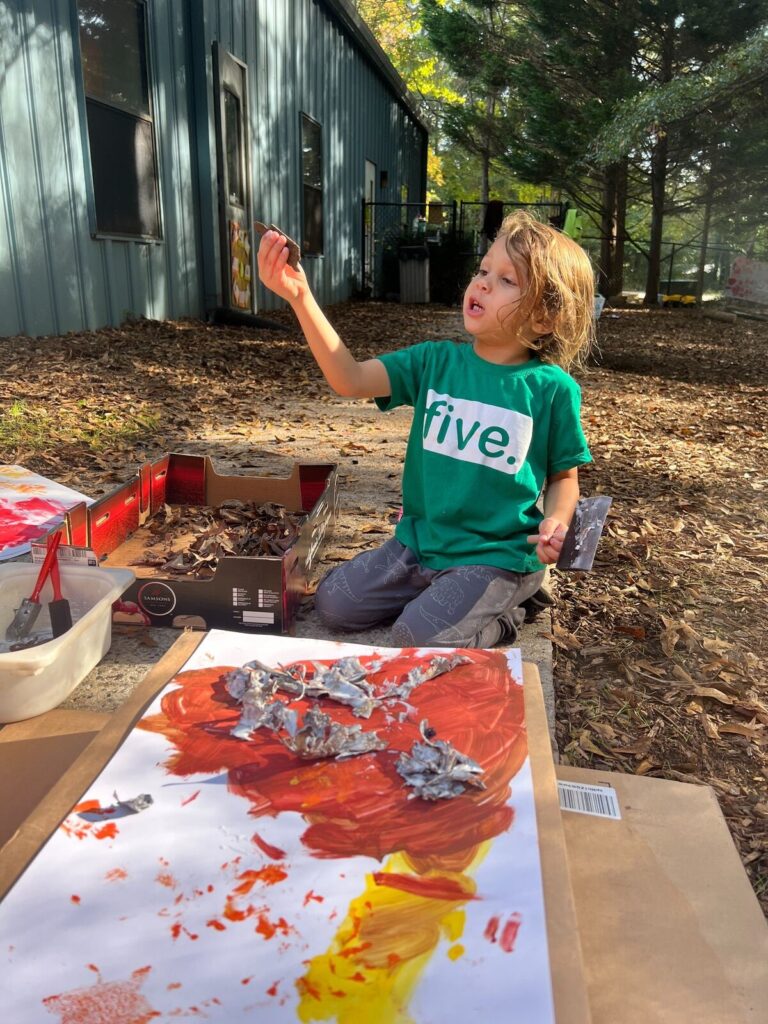
Reggio inspired classrooms are nontraditional spaces that allow children to move freely with access to learning materials and inspiring objects. Children are encouraged to express themselves through movement, music, play, or any other way that inspires them.
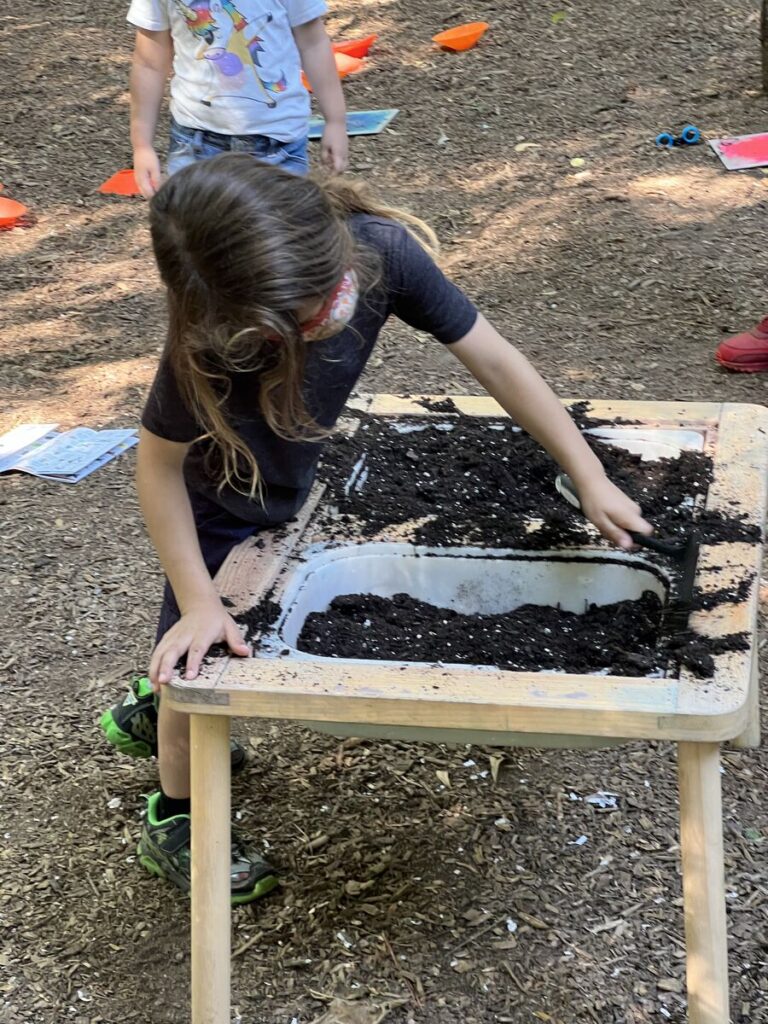
Some Reggio inspired classrooms are nature based with a large percentage of time spent outdoors exploring nature. Others are indoors with a vast supply of interesting objects and experiences designed to inspire all five senses. Activities that are executed as a team using collaboration is a cornerstone of a Reggio inspired classroom.
A typical Reggio Emilia classroom will have many or all of the following features.
Intentional Spaces
Reggio Emilia classrooms will have separate areas designed to inspire children in different areas of development. These areas include an atelier (creative expression area), sensory play area (may include sand, water, stones, etc), a constructing area, a writing station, a numbers center, and a gathering area referred to as a piazzo. Each area will have provocations, which are teacher planned but student led inspiring scenarios or activities.
Furniture Placement
Unlike other education models, like Montessori, Reggio Emilia does not require specific pieces of furniture. Some pieces you may see are a play kitchen, light table, work tables, easels, and floor mats. Flexible and fluid seating is important, as children may want to work independently or gather in a group. Reggio inspired classrooms are creative with furniture arrangement and typically include shelving to hold learning materials. In Reggio inspired classrooms, children are the main focus- not aesthetics or balance. Blank walls and bulletin boards are found in these classrooms in the beginning of the year in anticipation that they will be filled with art within weeks. Both in progress and completed work are displayed to tell the story of the children who occupy the space.
Neutral Colors
Reggio Emilia classrooms showcase children, not the curriculum. Most furniture, rugs, and walls are neutral in color because it is believed that the children should be the focus. It is also believed that children feel more comfortable in neutral colored environments because it closely mimics the outdoors. Simplicity is key with a Reggio classroom, which can be challenging for teachers who are accustomed to the bright, vivid colors or a traditional classroom.
"The wider the range of possibilities we offer children, the more intense will be their motivations and the richer their experiences."
Loris Malaguzzi Tweet
Values of Reggio Emilia Education Model
The Reggio Emilia education model follows a distinct set of values. A Reggio-inspired classroom means nothing if these values are not practiced.
Children Lead Their Growth and Education
All children are the architects of experiences to which they are capable of attributing sense and meaning. When educators allow for the extraordinary potential children have for learning, an impressive exchange follows.
One Hundred Languages
The philosophy that children are born with one hundred languages of expression means that they have infinite ways of thinking, understanding, interpreting, expressing, and exploring that do not follow the rules of socialization that they will inevitably encounter in their later years. When their extraordinary potential for creativity and problem solving is encouraged, not inhibited, multi-dimensional learning experiences follow. Verbal and non-verbal language is acknowledged with equal dignity in a Reggio Emilia classroom.
Participation
Active participation in one’s education is essential to cultivate lifelong learning. The expression of different perspectives, cultures, and approaches informs the quality of education in a Reggio-inspired model. Through participation and group interaction, children learn that they have an important place in the world.
Learning As A Process
In the Reggio Emilia classroom, learning subject matter doesn’t have a beginning and an end. Learning is a process that isn’t predetermined, but rather guided by the curiosities of the students. The process of learning inspires research, exchange, group discourse, and active participation.
Research
When children employ research strategies, they construct their learning process, innovate, and reformulate their previous knowledge base. Research is a necessary method for understanding the complexity of our changing world for both children and adults.
Documentation
Design and Organization of Learning Environments
Professional Growth and Evaluation
Does Reggio Emilia Accreditation Matter?
According to NAREA (North America Reggio Emilia Approach), no accreditation or teacher certification exists for the Reggio Emilia education model. Because, at its core, it is not considered to be an approach or method, but rather an understanding of child development theory and community constructed value systems, it can’t be quantified or certified.
There are 2,800 early education schools in North America that hold membership in NAREA professional learning initiatives, but it is understood that there are many more Reggio inspired schools that do not participate in professional development opportunities offered by NAREA.
What Are The Advantages of A Reggio Emilia Education?
Advocates for the Reggio Emilia education model recount six primary advantages to this type of early childhood education.
Social Skills
Community Involvement
Love Of Learning
Critical Thinking
Seek New Experiences
Is Reggio Emilia Right For Your Child?
There are several factors to consider when deciding whether a Reggio Emilia education is right for your child. Here are some things to think about when making a choice:
Local Reggio Emilia Options
Sadly, all Reggio Emilia schools are high quality. Since there are no accreditations or requirements to proclaim that a school is Reggio Emilia, some schools claim to be, but do not follow the philosophies very closely. Schedule a tour of your local Reggio Emilia schools and ask the following questions:
- Do the teachers have Reggio Emilia specific training?
- Is the school affiliated with NAREA?
- Does each classroom have an atelier?
- What community projects do the students participate in?
- Does the classroom look like a Reggio Emilia classroom?
Is It Reggio Emilia Or Reggio Inspired?
Understand The Responsibility of The Parents
Unlike most traditional schools, parents are expected to be involved with the Reggio Emilia school on a regular and meaningful basis. Here are a few ways you may be expected to engage in school life:
- Volunteer during the school day
- Volunteer during special events
- Represent the school within the community
- Help coordinate community engagement
If you and your family aim to raise a curious, community engaged, independent child filled with wonder and imagination, Reggio Emilia may be the right choice for you. This education model views a child as a whole being capable of self-guided education.